
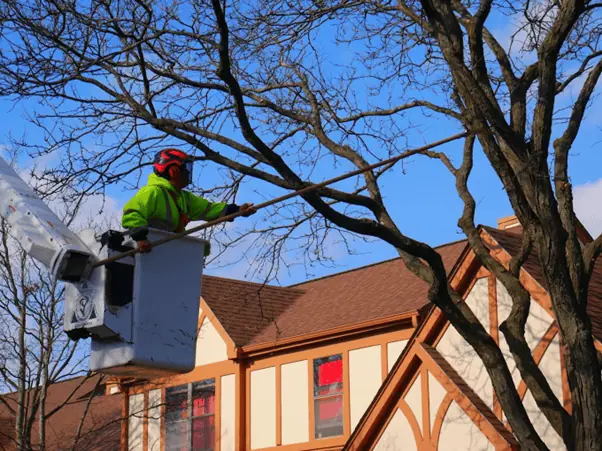
Spring storms hit fast in the Chicago area. Wind, heavy rain, and soaked ground can turn a small tree issue into a broken limb or a fallen tree. That risk grows after winter stress and early spring growth.
Good spring tree care helps cut that risk. It protects your home, your yard, and the long-term health of your trees. This guide covers the main steps in tree storm preparation, and it shows what Winkler Tree & Lawn Care looks for during spring visits across the Chicago area.
Start with a close look at each tree
A quick check from the sidewalk is not enough. Spring storm prep starts with a slow look at the trunk, the limbs, and the ground near the roots. Small defects can grow fast once heavy wind and rain arrive. That is why early spring is a good time to inspect your trees and make a plan.
Check for cracks and split bark
Winter can leave long cracks in the trunk or major limbs. Some stay small. Some spread once spring storms hit.
Fresh bark damage matters too. A split can point to stress inside the tree, not just on the surface.
Look for dead or hanging branches
Dead branches often stay in place through winter. Then a spring storm knocks them down.
Look up into the canopy. Search for bare limbs, broken tips, or branches that sit at odd angles.
Watch the ground near the base
The soil can tell you a lot. Raised soil, new lean, or exposed roots can point to root trouble.
That kind of damage needs a closer look. A stable tree should sit firm in the ground.
Focus on the limbs most likely to fail
Not every branch carries the same risk. Large limbs over a roof, driveway, sidewalk, or patio deserve the first look. Those branches can cause the most damage in a storm. Good tree storm preparation starts with the highest risk spots, not the easiest cuts.
Remove dead wood
Dead wood breaks fast. It has no flexibility, so wind puts it at risk right away.
A trained crew can remove that weight and lower the chance of a storm break.
Cut weak branch unions
Some branches grow at tight angles. Bark gets trapped in the union, and the connection stays weak.
Those limbs often split in spring wind. Pruning can reduce that risk.
Shorten long heavy limbs
A long limb with a lot of weight at the tip can fail in wet weather. Rain adds weight, and wind adds force.
A careful reduction cut can take stress off that branch and keep the tree balanced.
Prune for strength, not just for shape
A lot of homeowners think pruning is mostly cosmetic. In spring, it is about structure and safety. Good pruning helps a tree handle wind with less stress. It can cut breakage and help the tree hold a better form over time.
Thin crowded spots in the canopy
Crowded limbs rub together. That creates wounds and weak points.
A lighter canopy lets wind pass through with less force. That matters during Chicago spring storms.
Keep the main structure clear
Young and middle-aged trees need strong branch spacing. Two large stems that compete with each other can create future failure.
A pruning plan can guide growth and lower future storm risk.
Avoid random cuts
Topping and rough trimming create bigger problems. Those cuts push weak regrowth and leave large wounds.
That is one reason many homeowners call Winkler Tree & Lawn Care for spring tree care in Chicago. Their ISA Certified Arborists look at structure, health, and long-term value, not just what needs to come off that day.
Do not ignore the roots and soil
Storm resistance starts at the base of the tree. A full canopy means little if the roots are weak. Wet spring soil puts extra pressure on that root system. Root problems often stay hidden until a storm exposes them.
Check for girdling roots
Some roots wrap around the trunk and press into it over time. That slows water and nutrient flow.
The tree loses strength from the ground up. Winkler handles girdling root removal, and that service can make a real difference for the right tree.
Watch for compacted soil
Compacted soil limits air and water movement. Roots struggle in that kind of ground.
Lawns, foot traffic, driveways, and old construction often create this problem in Chicago area yards.
Keep mulch off the trunk
Mulch helps roots hold moisture and stay cooler. But mulch piled against the trunk can trap moisture and invite decay.
Keep the mulch ring wide and flat. Leave the base of the trunk clear.
Make lawn care work with your trees
Tree health and lawn care connect more than most people think. Products used on the lawn reach the root zone of nearby trees. Poor timing or heavy chemical use can add stress right before storm season. Spring tree care should include the whole yard, not just the canopy.
Use tree-safe fertilizer methods
Some lawn companies spray one liquid mix across the whole yard. That is fast, but it is not precise.
Winkler Tree & Lawn Care uses slow-release granular fertilizer in its 7-step lawn care program. That method feeds the lawn with less runoff and less stress on nearby trees.
Treat weeds with care
Spot treatment matters. A targeted weed spray keeps extra product off healthy turf and away from root zones.
That fits Winkler’s long focus on environmental care and tree preservation.
Time spring lawn work well
Early spring lawn work should support root health, not push fast surface growth. The yard needs balance.
A lawn plan built around trees gives both grass and trees a better chance to stay strong through storm season.
Support weak trees that still have value
Some trees need more than pruning. A mature tree with a split union or a heavy overextended limb may need extra support. That support can help preserve a tree that still has years of value left. For a company like Winkler, preservation comes first, so support systems matter.
Use cables for large limbs
A cable can reduce movement between weak stems or major limbs. Less movement means less stress at the weak point.
That support can lower the chance of failure in high wind.
Use rods for split stems
A rod helps hold a split union together. It adds strength at a spot that already shows strain.
This work needs proper placement and follow-up care. It is not a quick fix done by guesswork.
Recheck supported trees over time
Support systems need review. Trees grow, and hardware needs inspection.
Winkler offers rod and cable installation and maintenance, which helps homeowners protect mature trees without rushing into removal.
Know the signs that point to removal
Most trees deserve a fair chance at preservation. Some do not have a safe future. A tree with severe structural damage can put people and property at risk during spring storms. Homeowners need clear facts here.
Look for major trunk damage
A deep crack, large cavity, or hollow base can mean serious loss of strength. Those defects matter more in wet and windy weather.
A close inspection gives a clearer picture of the risk.
Notice major lean or root lift
A tree that suddenly leans has a problem. Soil that lifts near the roots points to loss of support.
That tree should be checked right away.
Ask for a clear recommendation
This part matters. A homeowner should hear why a tree can stay, why it needs support, or why it needs removal.
Winkler Tree & Lawn Care makes that process more straightforward. Their sales arborists are salaried, not paid by commission, so the focus stays on the right call for the tree and the property.
Get your trees ready before the next Chicago storm
The weather in Chicago can change really fast in the spring. It only takes one storm to break a weak branch or show a problem that has been there for a long time. If you take a time now to check your trees you can avoid a lot of trouble later.
If you are not sure what to look for our team at Winkler Tree & Lawn Care can help you. We have been, in the Chicago area since 1975. We help people figure out what their trees need. Our goal is always to keep your trees healthy and safe so they can stay where they are.
